Kitchen Lab: The Slow-Motion Energy Experiment
 Erin Crowell
Teach your kids about blood sugar stability with this hands-on Kitchen Lab! See how fiber and protein slow down energy absorption using the "Flow Race
Ever wonder why some snacks leave your kids bouncing off the walls only to crash twenty minutes later, while others keep them focused and fueled for hours? In our recent deep dive into Fiber vs Protein, we talked about how these two nutrients act like "speed bumps" for your child’s energy.
But at Happy Kids Nutrition Academy, we believe that seeing is believing! It’s one thing to tell a teen that fiber slows down sugar absorption; it’s another thing entirely for them to watch it happen in real-time.
Welcome to the Kitchen Lab: The Slow-Motion Energy Experiment. This hands-on activity is designed for preteens and teens to visualize exactly how different nutrients change the "speed" of energy in their bodies. By the end of this lab, your student will understand why a sugary drink behaves differently in their system than a high-fiber, high-protein snack.
The Science Concept: Viscosity and Energy Flow
In this experiment, we are using water to represent the liquid in our digestive system and food coloring (if you have it) to represent "energy." We want to see how adding sugar, fiber, and protein changes the viscosity: or the thickness: of that liquid.
In the human body, when we eat simple sugars (like soda or candy), they dissolve quickly and rush into the bloodstream. This causes a "spike." But when we add fiber (like oats or chia) and protein (like powder or egg whites), the mixture in our stomach becomes thicker. This thickness slows down the "exit" of energy into the bloodstream, providing that steady, slow-motion energy we need for school, sports, and focus.
Materials Needed
Gather these simple items from your pantry to get started:
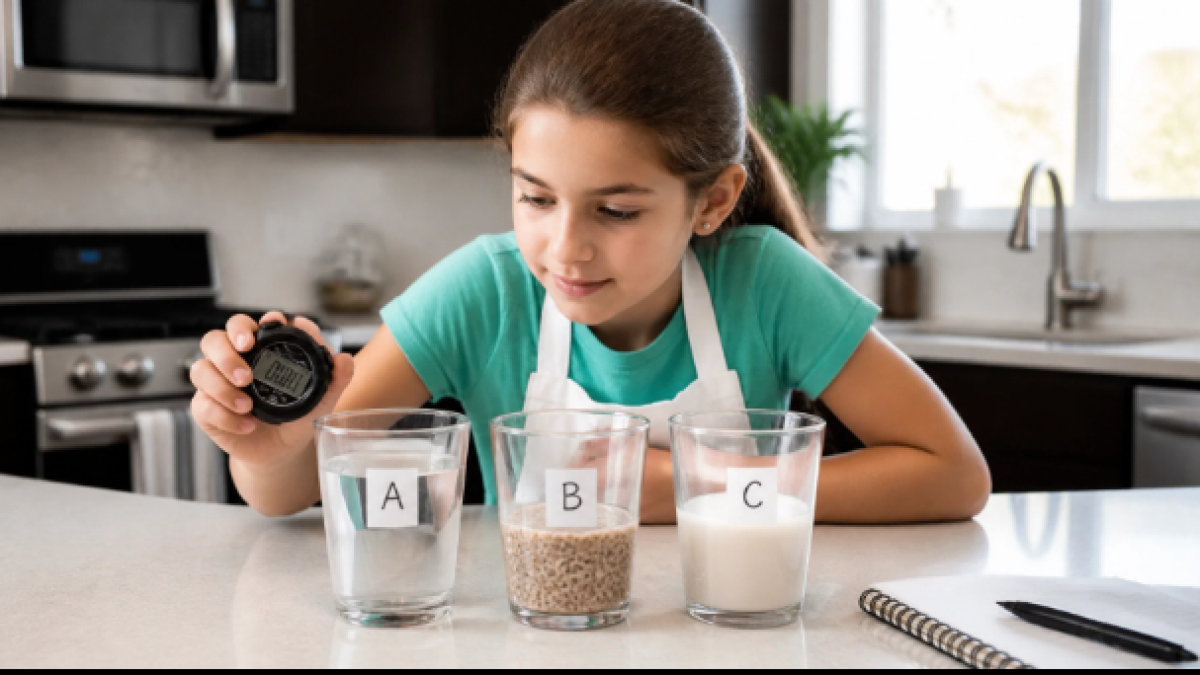
- 3 Clear Glasses (labeled A, B, and C)
- Water (room temperature)
- Sugar (white table sugar)
- Fiber Source: 2 tablespoons of chia seeds or quick oats
- Protein Source: 1 scoop of protein powder (or 2 egg whites)
- Stopwatch (a phone timer works great!)
- A Flat Plate (white is best for visibility)
- Food Coloring (optional, but helps "see" the energy)
- Spoons for stirring
Step-by-Step Procedure
Phase 1: The Mixing Station
- Glass A (The "Sugar Rush"): Fill with 1/2 cup of water and 2 tablespoons of sugar. Add 2 drops of food coloring. Stir until dissolved. This represents a high-sugar drink with no "speed bumps."
- Glass B (The "Fiber Buffer"): Fill with 1/2 cup of water and 2 tablespoons of chia seeds or oats. Stir well.
- Glass C (The "Protein Power"): Fill with 1/2 cup of water and 1 scoop of protein powder (or egg whites). Stir until mostly smooth.
Phase 2: The Wait-and-Watch
Set your stopwatch for 15 minutes.
- Every 5 minutes, give Glass B (Fiber) and Glass C (Protein) a quick stir.
- Observe how the texture changes. Does the water stay thin, or does it start to look like a gel?
Phase 3: The Slow-Motion Energy Race
Now it’s time for the "Race!" We are going to test the Flow Speed.
- Take your flat plate and prop one side up on a small book so it is at a slight tilt.
- Using a spoon, take exactly one tablespoon of the liquid from Glass A and pour it at the top of the "ramp" (the plate). Use your stopwatch to see how many seconds it takes to reach the bottom.
- Clean the plate and repeat with Glass B (Fiber).
- Clean the plate and repeat with Glass C (Protein).
Data Collection Chart
Record your findings below. Scientific observation is all about the details!
| Sample | Nutrient Type | Initial Appearance | Viscosity After 15 Mins (Thin, Medium, or Thick) | Flow Speed (Seconds to reach bottom) |
|---|---|---|---|---|
| Glass A | Simple Sugar | Clear/Thin | ||
| Glass B | Fiber | Seeds/Oats in water | ||
| Glass C | Protein | Cloudy/Milky |
Why Does This Matter for Focus?
When your preteen or teen sits down for a math test, their brain needs a constant, steady stream of glucose (energy).
If they had a snack like Glass A, the "energy" (sugar) flows through their system so fast that the brain gets a huge hit all at once, followed by a "drought" when the sugar is gone. This is the Sugar Crash.
If they had a snack more like Glass B or C, the mixture stays thick in the stomach. The energy is released slowly, like a dripping faucet rather than a firehose. This is what we call Steady-State Focus.
At Happy Kids Nutrition Academy, we explore these concepts in depth through our live classes. We don't just tell kids what to eat; we show them the "why" through experiments just like this one!
Lab Report Conclusions
Students, use the lines below to summarize your findings. If you’re a parent, encourage your child to explain the "why" in their own words!
1. Which sample had the highest viscosity (the thickest texture) after 15 minutes?
2. How did the "Flow Speed" of the sugar water compare to the fiber or protein mixtures?
3. Based on this lab, why would a snack with fiber and protein help you stay focused during a long afternoon of schoolwork?
Ready to Learn More?
If your child enjoyed this Kitchen Lab, they will love our interactive group classes! We believe that empowering the next generation starts in the kitchen. Our organization provides evidence-based education that makes nutrition, exercise science, and food science accessible and fun for the 8-18 age group.
- Check out our upcoming sessions on our Calendar.
- Explore our full range of Nutrition Courses.
- Join our community of healthy families at the Happy Kids Nutrition Academy Home Page.
We love seeing your results! If you try this experiment at home, feel free to reach out through our Support page and tell us which "Energy Race" winner surprised you the most!

Categories: : Kitchen Lab, Nutrition Education