Protein Power: How Much Does Your Growing Child Really Need?
 Erin Crowell
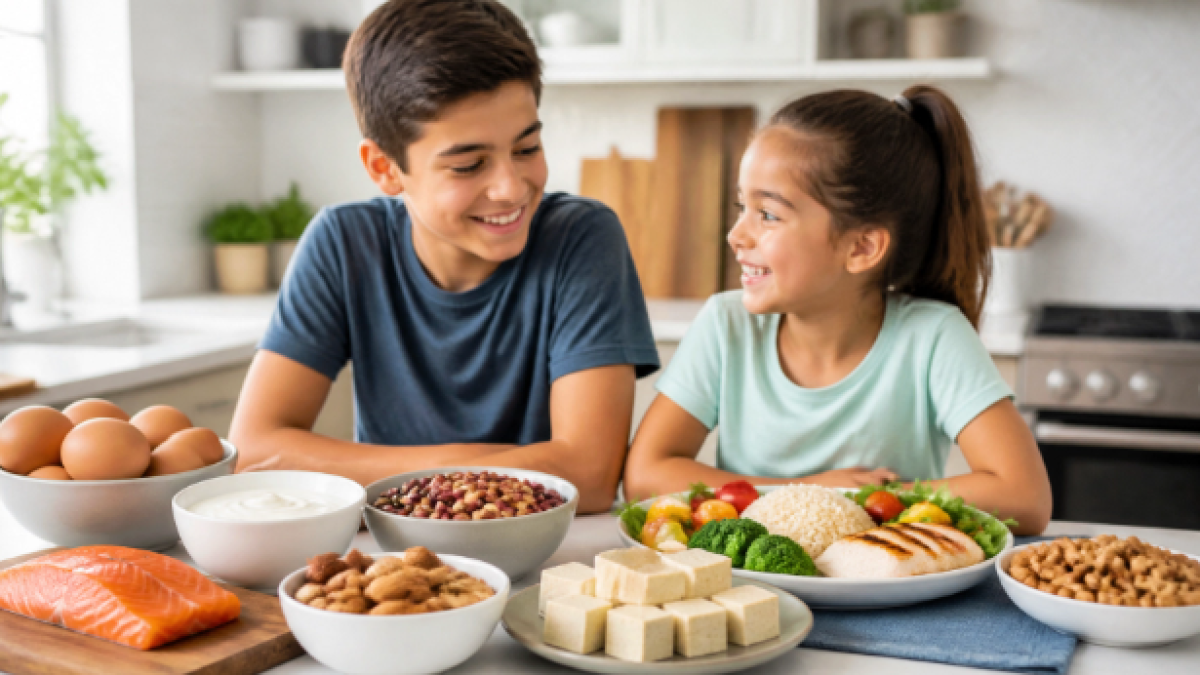
How much protein does your child really need? Learn the science, RDAs for teens, and top food sources for healthy growth in our latest guide.
Protein Power: How Much Does Your Growing Child Really Need?

When we think of protein, our minds often jump to bodybuilders at the gym or professional athletes drinking giant shakes. But here at Happy Kids Nutrition Academy, we want to share a little secret: protein isn't just for the heavy lifters. It is actually the "building block" for almost everything in your child’s body!
From the shiny hair on their head and the strength of their fingernails to the powerful muscles that help them run across the soccer field and the sharp brain they use to ace that math test: protein is the star of the show. If your child is in a "growth spurt" phase (which, let's be honest, feels like all the time), protein is working overtime behind the scenes.
But as a parent, it can be confusing to know if they’re getting enough. Are they getting too much? Does a teen soccer player need more than a preteen who loves art? Today, we’re breaking down the science, the math, and the meal plans to help you feel confident about your family’s protein intake.
The Science: What Exactly is Protein?
Think of protein as a giant Lego set. The entire structure is the protein, but it’s made up of hundreds of tiny individual bricks called amino acids.
There are 20 different types of amino acids that the body needs to function. Our bodies are pretty cool and can actually manufacture 11 of these on their own. However, there are nine "essential" amino acids that our bodies cannot make. These must come from the food we eat.
When your child eats a piece of chicken, a bowl of lentils, or a hard-boiled egg, their digestive system breaks that protein down into those individual "Lego bricks." Then, their body picks them up and moves them to wherever they are needed most.
- Repairing Tissue: Did your child scrape their knee? Amino acids are there to rebuild the skin.
- Muscle Growth: As bones grow longer, muscles must grow too. Protein provides the material for that growth.
- Enzymes and Hormones: Protein helps create the chemicals that manage everything from digestion to mood.
The Numbers: How Much is Enough? (The RDA Math)
You might have heard of the RDA, or Recommended Dietary Allowance. This is the amount of a nutrient that is considered "safely adequate" for almost all healthy people in a specific age group. It’s essentially the baseline for good health.
According to the NIH Office of Dietary Supplements, kids and teens have different needs based on their stage of development. Here is the simple math you can use at home:
For Kids Aged 4–13
In this stage of steady growth, kids generally need about 0.95 grams of protein per kilogram of body weight.
The Math Example:
If your 10-year-old weighs 30 kg (about 66 lbs):
- 30 kg x 0.95 = 28.5 grams of protein per day.
For Teens Aged 14–18
As growth starts to stabilize into adulthood, the requirement drops slightly to about 0.85 grams of protein per kilogram of body weight.
The Math Example:
If your 16-year-old weighs 60 kg (about 132 lbs):
- 60 kg x 0.85 = 51 grams of protein per day.
Tip: To convert pounds to kilograms, simply divide the weight in pounds by 2.2!

The "Athlete" Factor: Extra Fuel for Extra Movement
If you have a child who is highly active: perhaps they are on a competitive swim team, play travel soccer, or spend hours in dance rehearsals: their needs will likely be higher than the standard RDA.
When we exercise intensely, we create tiny "micro-tears" in our muscles. This is a normal part of getting stronger! To repair those tears and build stronger muscle fibers, the body needs extra protein. Research suggests that active teens in heavy training may need up to 1.2 to 1.5 grams of protein per kilogram of body weight.
For a 60 kg teen athlete, that could mean bumping their intake up to 72–90 grams per day. However, it’s important to remember that more isn't always better. Going way beyond 2.0g/kg doesn't usually provide extra benefits and can sometimes displace other important nutrients like healthy fats and energizing carbohydrates. For more on how athletes manage their health, check out our organization’s courses on sports nutrition!

Quality Matters: Complete vs. Incomplete Proteins
Not all protein "bricks" are the same. We generally categorize protein into two groups:
1. Complete Proteins
These are foods that contain all nine essential amino acids in the right proportions. Most animal-based products fall into this category:
- Eggs (the "gold standard" for protein quality!)
- Dairy (milk, yogurt, cheese)
- Lean meats (chicken, turkey, beef)
- Fish and seafood
- Plant-based exception: Soy (tofu, edamame) and quinoa are also complete proteins!
2. Incomplete Proteins
Most plant-based foods are "incomplete," meaning they are low in one or two of the essential amino acids. But don't worry! You don't need to eat meat to get all your protein. The trick is complementary pairing.
When you pair two incomplete proteins together, they "fill in the gaps" for each other.
- Beans and Rice: The classic combo!
- Whole Grain Bread and Peanut Butter: A childhood favorite that works perfectly.
- Hummus and Pita: Chickpeas + wheat = a complete amino acid profile.
Encouraging a variety of sources ensures your child is getting all the different types of "Lego bricks" they need to grow.

The Balance: Making it Work on the Plate
While protein is powerful, it shouldn't hog the whole plate. At Happy Kids Nutrition Academy, we teach our students the 50/25/25 rule to keep things simple and balanced.
Imagine your child’s plate:
- 50% Veggies and Fruits: For vitamins, minerals, and fiber.
- 25% Protein: To build and repair.
- 25% Carbohydrates: To provide the energy their brain and body need to move.
Following the Harvard Healthy Eating Plate guidelines is a fantastic way to visualize this. When we focus too much on just one category, we miss out on the synergy of how nutrients work together. For instance, did you know that eating Vitamin C (like an orange) helps your body absorb the iron found in plant-based proteins (like beans)?

Final Thoughts for Parents
The journey to raising a healthy eater isn't about perfection; it's about education. Most kids who eat a varied diet are likely meeting their protein needs without even trying. If you’re worried, focus on adding "protein wins" throughout the day: like a Greek yogurt at breakfast or a handful of almonds as an after-school snack: rather than stressing over a single meal.
We are here to support you and your family on this journey. Whether you're navigating picky eating or fueling a high-school varsity athlete, understanding the "why" behind the food makes every choice a little easier.
Want to dive deeper? Explore our all-classes page to find the perfect course for your teen or preteen. Let’s empower the next generation to make healthy choices, one building block at a time
Categories: : growth & development, Sports Nutrition, Teen Nutrition